 May 23 2026
 May 16 2026
 May 09 2026
 May 02 2026
 Apr 25 2026
 Apr 18 2026
 Apr 11 2026
 Apr 04 2026
 Mar 28 2026
 Mar 21 2026
 Mar 14 2026
 Mar 07 2026
 Feb 28 2026
 Feb 21 2026
 Feb 14 2026
 Feb 07 2026
 Jan 31 2026
 Jan 24 2026
 Jan 17 2026
 Jan 10 2026
 Jan 03 2026
 Dec 27 2025
 13-26 December 2025
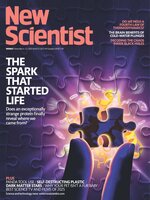 Dec 06 2025
New Scientist covers the latest developments in science and technology that will impact your world. New Scientist employs and commissions the best writers in their fields from all over the world. Our editorial team provide cutting-edge news, award-winning features and reports, written in concise and clear language that puts discoveries and advances in the context of everyday life today and in the future.
How to be OK with AI • Mathematicians seem to have artificial intelligence figured out, but can the rest of us?
New Scientist
Global warming seems to have accelerated • The rate of temperature rise appears to have picked up since 2010
Divide over causes of faster warming • Whether human-made climate change or natural fluctuations are to blame, it’s important we understand what is behind the recent surge in global temperatures, reports Alec Luhn
Can species evolve fast enough to survive as the planet heats up? • A wildflower that adapted to severe drought has raised hopes that rapid evolution will rescue species hit by global warming, finds Michael Le Page
King penguins change their behaviour as temperatures rise
Miniature magnet rivals behemoths in strength
Smell test could help us spot Parkinson’s disease sooner
Single-celled organism shows surprising level of intelligence
Our extinct relatives may have had difficult births
Fixing quantum’s biggest problem • We are getting closer than ever before to being able to build quantum computers that can correct their own mistakes, discovers Karmela Padavic-Callaghan
One issue no quantum computer can solve
Mathematics is having an AI revolution • The speed at which artificial intelligence is gaining in mathematical ability has taken many by surprise and rewriting what it means to be a mathematician, reports Alex Wilkins
Data centres to use human brain cells • Cortical Labs plans to use neuron-filled chips to expand its cloud computing service
Sharing genetic risk scores could carry hidden dangers
Orcas may be behind some dolphin strandings
Cosmic explosion is the brightest of its kind
Taking multivitamins may slightly slow rates of ageing
Is this why we haven’t yet made contact with aliens?
Farming made us evolve the same way • Examining both ancient and modern DNA has shown how people around the world converged
‘Weirdo’ reptile went from four legs to two in adolescence
Why are we so suspicious of do-gooders? • Research shows that we tend to discount a person’s good deeds if they stand to benefit from them. David Robson explores where this instinct comes from
What is a galaxy? That’s a difficult question to answer • Figuring out what really counts as a galaxy could shake up astrophysics, cosmology and particle physics, says Chanda Prescod-Weinstein
New horizons
“We’re in the middle of the story” • Climate activist and author Rebecca Solnit tells Rowan Hooper why she still has hope even in these “catastrophic” times
New Scientist recommends
Use of weapons • It is scarily fascinating to read about the US military’s journey into AI warfare. But what happens next, asks Matthew Sparkes
Two more great reads on AI and warfare
Your letters
In the eyes of the beholders • A radical idea suggests the cosmos is stitched together from interlocking perspectives and experiences, discovers Jo Marchant
“Psychopathy is a real psychological disorder and it can be treated” • Many psychopaths want to change their behaviour, and they deserve support to help them do so, psychologist Abigail Marsh tells Sabrina Weiss
A very serious guide to buying a robot butler • Need more help around the house? Chris Stokel-Walker looks into whether a robot...